Was Barnabas Ever Heard From Again After the Break Up With Paul
Just before Paul's second missionary journey a controversy erupted in Syrian Antioch regarding whether new gentile converts should be circumcised or not. Paul and Barnabas, every bit well as others, are sent to Jerusalem to settle the split in the church. The unabridged matter is debated, a determination is arrived at, and the ii evangelists return home to Antioch in late autumn of 49 A.D. with what was decided. Delight see the article in this series entitled "Controversies in the Church" for more information.
Paul begins planning his second missionary journey in belatedly autumn of 49 A.D. Information technology originated in a want expressed by him to Barnabas, that they should revisit all the cities where they had preached the Gospel and founded churches (Acts 15:36). He felt that he was not called to spend a peaceful, though laborious, life at Antioch, but that his truthful work was "far off among the Gentiles" (Acts 22:21).
The Apostle Paul knew that his campaigns were not ended. He knew that, as the soldier of Jesus Christ, he must not rest from his warfare, just must "endure hardness," that he might please Him who had called him (2Timothy 2:3 - four). Equally a careful physician, he remembered that they, whose recovery from sin had been begun, might be in danger of relapse.
The words actually recorded as used by Apostle Paul on this occasion are, "Come, let us plow back and visit our brethren in every city, where we have announced the discussion of the Lord, and let us see how they fare." Nosotros find here, for the first time, a trace of that tender solicitude apropos his converts, that hostage longing to behold their faces, which appears in the letters which he wrote after, as one of the most remarkable, and one of the almost attractive, features of his character.
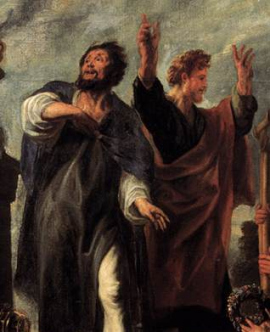
Paul and Barnabas
Paul was the speaker and non Barnabas. The feelings of Barnabas might non be so deep, nor his anxiety and so urgent. Paul idea doubtless of the Pisidians and Lycaonians, as he idea after at Athens and Corinth of the Thessalonians, from whom he had been lately "endeavoring to see their face with great want" (1Thessalonians 2:17, 3:10). His wish was to revisit every metropolis where converts had been made.
This plan past Paul, yet, of a combined visitation of the churches with Barnabas was marred by an outbreak of human nature. The two apostolic friends were separated from each other by a quarrel, which proved that they were indeed, every bit they had lately told the Lystrians, "men of like passions" with others (Acts 14:fifteen).
Barnabas was unwilling to undertake the journey unless he were accompanied by his relation Mark. Paul could not consent to the companionship of one who split from them, simply a few years prior, at Perga in Pamphylia. Neither apostle was willing to yield his opinion to the other. This quarrel was much more closely connected with personal feelings. There is little doubtfulness that severe words were spoken on the occasion.
It is unwise to be over-anxious to dilute the words of Scripture, and to exempt even Apostles from blame. By such criticism we lose much of the education which the honest tape of their lives was intended to convey. Without attempting to remainder too nicely the faults on either side, our simplest course is to believe that, as in most quarrels, both Barnabas and Paul were to blame for the separate.
Barnabas was adamant to accept with them John who was called Mark.
But Paul did not think information technology practiced to have him because he had departed from them at Pamphylia, and did not get with them to the work. As a result, such a sharp contention arose betwixt them that they parted (split) from one another (Acts 15:37 - 39, HBFV).
Paul'south natural disposition was impetuous and impatient, easily kindled to indignation, and overbearing. Barnabas had shown his weakness when he yielded to the influence of Peter and the Judaizers. The remembrance of the indirect censure he and so received may have been perpetually irritated by the consciousness that his position was condign daily more and more subordinate to that of the friend who rebuked him. Once he was spoken of as chief of those "prophets at Antioch," among whom Saul was the concluding. Now his proper noun was scarcely heard, except when he was mentioned equally the companion of Paul.
In short, this is one of those quarrels in which, by placing ourselves in imagination on the 1 side and the other, we can alternately justify both, and hands see that the purest Christian zeal, when combined with human weakness and partiality, may have led to the misunderstanding. How could Paul consent to take with him a companion like Mark who could evidence an embarrassment and a hinderance? Such a chore equally that of spreading the Gospel of God in a hostile world needs a resolute will and an undaunted courage. And the piece of work is besides sacred to be put in jeopardy by any experiments.
Marking had been tried once and found wanting. And Barnabas would not exist without strong arguments to defend the justice of his claims. It was hard to wait him to resign his interest in one who had cost him much feet and many prayers. His dear wish was to encounter his young kinsman approving himself as a missionary of Christ. Now, too, he had been won back to a willing obedience, he had come from his home at Jerusalem, he was ready now to face all the difficulties and dangers of the enterprise. To repel him in the moment of his repentance was surely "to pause a bruised reed" and to "quench the smoking flax" (Matthew 12:xx).
It is not hard to sympathise the obstinacy with which each of the disputants, when his feelings were in one case excited, clung to his stance equally to a sacred truth. The only class which now remained was to separate and choose ii different paths and to labor independently. We cannot, however, suppose that Paul and Barnabas parted, like enemies, in acrimony and hatred. It is very likely that they fabricated a deliberate and amicable arrangement to divide the region of their beginning mission betwixt them, Paul taking the continental, and Barnabas the insular, function of the proposed visitation.
One stream of missionary labor had been divided, and the regions blest by the waters of life were proportionally multiplied. Apostle Paul speaks of Barnabas afterwards as of an Apostle actively engaged in his Main'south service (Colossians 4:10). We know aught of the details of his life beyond the moment of his sailing for Cyprus, simply we may reasonably aspect to him non only the confirming of the outset converts, but the full establishment of the Church in his native isle.
At Paphos, the impure idolatry gradually retreated earlier the presence of Christianity. And Salamis has earned an eminent place in Christian history, through the writings of its bishop, Epiphanius. Mark, too, who began his career as a "minister" of the Gospel in this island (Acts 3:5) justified the skilful opinion of his kinsman Barnabas.
The severity of Paul, notwithstanding, may have been of eventual service to his character, in leading him to feel more deeply the serious importance of the piece of work he had undertaken. And the time came when Paul himself acknowledged, with affectionate tenderness, non only that Mark had once again become his "boyfriend laborer" (Philemon 1:24) only that he was "assisting to the ministry" and one of the causes of his ain "comfort" (Colossians 4:10 - 11).
It seems that Barnabas was the beginning to have his divergence. He decided to split with Paul and take Marker with him to revisit their labors on the island of Cyprus (Acts 15:39 - 41). Paul took Silas with him to Tarsus and officially started his second missionary journey.
Previous - Next
Listing of all Capacity
franklininsconothe.blogspot.com
Source: https://www.biblestudy.org/apostlepaul/life-epistles-of-apostle-paul/paul-barnabas-split.html
0 Response to "Was Barnabas Ever Heard From Again After the Break Up With Paul"
Publicar un comentario